 In 1974 I witnessed a 3-year-old girl receiving a calculator as a gift.
I suggested it was a disservice, as the girl couldn’t already do math by herself.
I was ignored, and the calculator became a crutch. The girl’s math skills were ignored, and her career hobbled.
Why? Like any muscle not regularly exercised, our brains become atrophied if we don’t fully use them.
Today’s society faces a similar scenario as we voluntarily abdicate our creative and analytical skills to artificial intelligence.
Now, I’m regularly asked how I feel about AI since, as a writer, I’m (arguably) replaceable by ChatGPT.
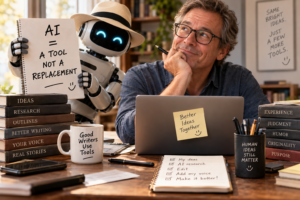
So I’ll admit I sometimes use AI. Artificial intelligence may be one of the most powerful writing tools invented in decades. It’s helpful for research, first drafts, organizing my thinking, and structuring my workflow.
But the key word is tool.
AI supplies speed, organization, alternatives, research assistance, and an endlessly patient editorial partner. I supply judgment, experience, personality, originality, and purpose.
Just as a plow made farming more efficient, AI can make writing more efficient. It can save time gathering background information, though you’d better double-check your facts. Like an errant child, AI sometimes gets things wrong and needs supervision.
Furthermore, you should never use AI-generated copy without significant editing, rewriting, and original content. Otherwise, a computer is doing the writing and you’re merely putting your name on it.
That’s cheating. It also calls into question who legally owns the work.
AI works best when it assists, rather than replaces, the writer. Tell it, “Write an article about marketing,” and you’ll get something perfectly forgettable. Give it your ideas, experiences, audience, objectives, and examples, and it’s a useful writing partner.
If you start with your own thinking, AI can develop outlines, brainstorm ideas, identify gaps, simplify complicated subjects, and spot repetition, awkward transitions, and confusing passages.
And most importantly, always protect your own voice. Remember that AI produces generic language. Your humor, experiences, opinions, and stories create authenticity.
Thus AI can explain why customer service matters. It can’t replace your story about the furious customer and the lesson he taught you 30 years ago.
Bottom line: don’t tell AI “Write this for me.” Tell it “Help me write this better.”
That’s how artificial intelligence becomes genuinely intelligent writing.
With that said, I wish you a week of profitable marketing.
——————-
Get original branding ideas. https://amzn.to/4hoslft.
About the Author: Rob Weinberg